
FINER
150–250 µm
0.15–0.25 mm
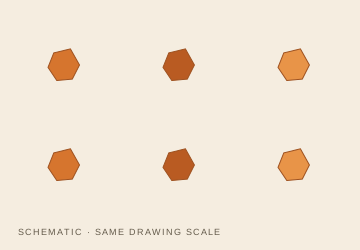
A finer particle appearance within this comparison.
Illustrated example: 200 µm
Prepare this sample enquiry ↗APRICOT KERNEL SHELL PARTICLE SIZES
Compare three micron ranges using a common drawing scale, then explore the original granule reference photographs.
0.15–0.25 mm
A finer particle appearance within this comparison.
Illustrated example: 200 µm
Prepare this sample enquiry ↗0.25–0.40 mm
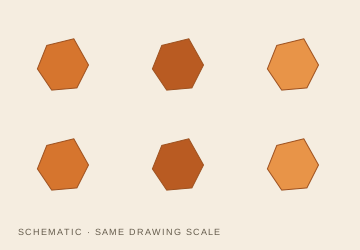
An intermediate particle appearance within this comparison.
Illustrated example: 325 µm
Prepare this sample enquiry ↗0.40–0.60 mm
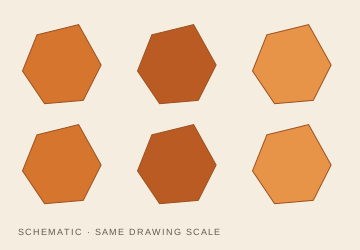
A more pronounced particle appearance within this comparison.
Illustrated example: 500 µm
Prepare this sample enquiry ↗Schematic comparison. The drawings are illustrations, not product photographs or measured particle distributions. Each uses a representative size within the stated range. Confirm the selected sample and specification before ordering.
READING THE NUMBERS
It describes a target size interval of 0.15–0.25 millimetres. The lower and upper numbers belong to the range; they are not two different products.
Within these three options, 150–250 µm is the finer range, 250–400 µm is intermediate and 400–600 µm is coarser. The drawing examples use 200, 325 and 500 µm respectively.
The final texture also depends on particle shape, distribution, loading and the surrounding formulation. Select an identified sample and confirm the current sieve specification for your application.
REAL GRANULE PHOTOGRAPHY
These photographs show three mesh-labelled reference samples. They are presented separately from the micron diagrams because they have not been matched to those three ranges.
Source sample labels: 100/60, 60/40 and 40/30 mesh. These are reference photographs, not calibrated images of the micron options above.
A quick note on mesh. Mesh counts sieve openings per linear inch. Within the same sieve standard, a higher mesh number generally means a finer opening. Microns (µm) express size directly; an exact conversion requires the sieve standard and aperture specification.
Include your required micron or mesh range, sieve standard and application in the enquiry. Custom requirements are reviewed against the relevant product specification.
If the required size is not yet fixed, describe the target appearance and application. A physical comparison in the actual base helps connect the diagram to the finished product.
Microns, mesh and the specification ↗FROM MATERIAL TO POSSIBILITY
Bring your application, target particle size and quantities. Build a clear sample or bulk enquiry.